
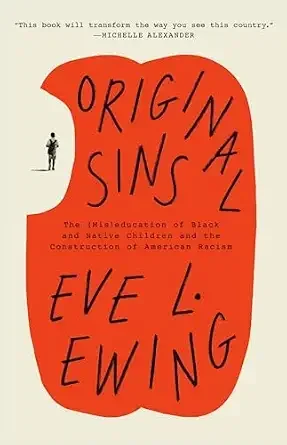
“Original Sins” by Eve l. ewing
The Revolutionary Book Club Meeting #003
Oct 4, 2026
During the third meeting of The Revolutionary Book Club, members finalized the upcoming book selection and engaged in an extensive discussion critiquing systemic inequities within educational systems.
Book Selection for the Next Reading Rotation
The group selected Erased as the primary reading choice for the next rotation. Additionally, two alternative reading options were suggested for consideration once Erased is completed.
Analysis of Original Sins and Structural Education Flaws
The discussion delved deeply into Original Sins and the structural flaws inherent in educational systems. Participants examined how historical figures such as Louis Agassiz established pervasive racist policies, and attendees expressed profound shock and frustration regarding the suppressed realities of American history. The conversation highlighted how public education systems were historically designed to shape compliant laborers and consumers, systematically weaponizing notions of racial inferiority to justify labor and land exploitation. Traditional schooling was characterized as a stratified training ground focused on societal control, leading to the conclusion that restructuring education requires a fundamental shift away from capitalist accumulation toward holistic learning models.
Purpose and Evolution of Education
Addressing the purpose and evolution of education, the group reflected on how early childhood education, such as kindergarten, has shifted over the past three decades from socialization toward aggressive academic consumption. Attendees voiced strong support for a communitarian education model prioritizing equity, experimentation, and the collective social good. Examples like the Rochester freedom schools—rooted in African traditions while adhering to state standards—were highlighted alongside intergenerational learning models that integrate arts, joy, and rest with traditional academic subjects.
Systemic Critique of Capitalism and Social Change
In a systemic critique of capitalism and social change, members observed that public schools frequently reflect economic structures that rely on poverty. True social transformation, the group noted, requires decolonizing minds through education systems. American hyper-capitalism was contrasted with European models that combine capitalist economic frameworks with socialist healthcare infrastructure. Looking ahead, participants noted potential labor movements, such as a 2028 union convergence that could trigger widespread labor strikes, and advocated focusing coalition efforts on economic rights, decarceration, and political rights.
Book Analysis and Discussion Insights
Further analysis of Erased highlighted the richness of its footnotes and noted that the text features quotes from a Stanford classmate.
Book Selection and Author Engagement
Following the finalization of Erased as the next book choice, ongoing outreach was noted regarding a potential appearance by the author at a November meeting. To support equitable economic practices, the group identified alternative Black- and Brown-owned bookstores to utilize instead of major online retailers.
Educational Philosophies and School Discipline
Exploring educational philosophies and discipline, members discussed the book's examination of standardized testing and the history of entrance examinations. Rigid, punitive disciplinary models—such as those used in KIPP schools—were contrasted with experiential and immersive learning approaches, emphasizing the structural distinction between equitable teaching philosophies and rigid instructional methods.
Social Dynamics and Historical Perspectives
Reflecting on broader social dynamics and historical perspectives, the group discussed youth responses to fraternity culture in the wake of the Cornell University incident, as well as the book's historical framing of biracial identity as rooted in fragility.
Next steps
Next steps for the group include suggesting two additional book options for the subsequent reading rotation once Erased is finished, compiling and sending notes on group organization and ideology, and sharing links regarding additional books and the refugee school. Suitability evaluations will be conducted for How the Word Is Passed for future recommendations, and outreach will be made to invite the author of Erased to an upcoming meeting. Additionally, the website will be updated with the new book selection, the list of Black- and Brown-owned bookstores will be distributed, and local education and social change initiatives will be researched for potential support. Finally, meeting notifications will be dispatched, and a follow-up conversation regarding events at Cornell University will be conducted.
